
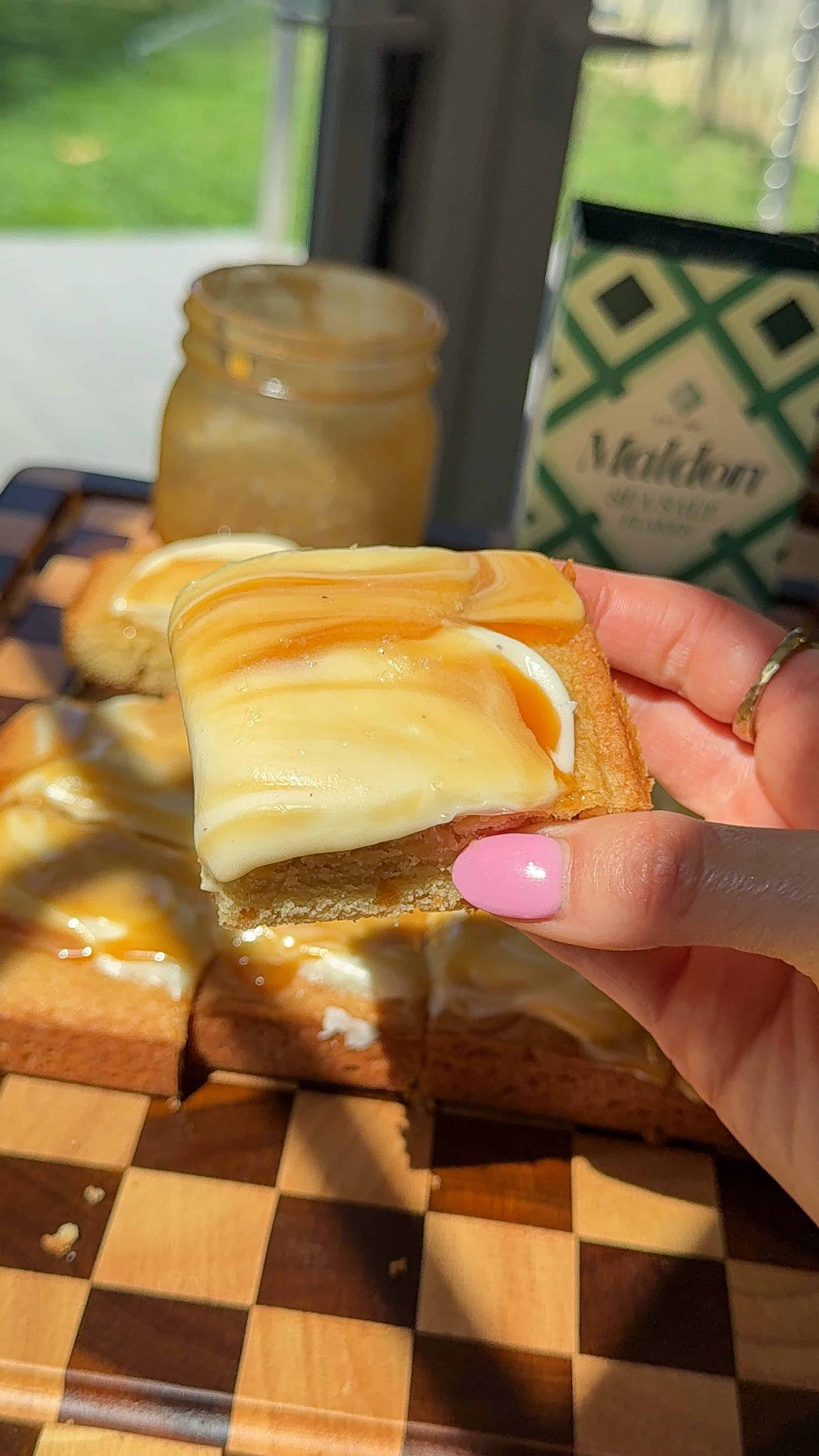
Hi — these are honestly my current obsession. Picture a soft, pillowy espresso-spiked cookie that’s just sweet enough, piled with the dreamiest cream cheese frosting, and finished with a glossy drizzle of salted caramel and flaky sea salt. This recipe grew from my OG salted caramel cookie (family favorite — my sister-in-law literally begs me for them), and adding coffee felt like destiny. If you love lattes, coffee-flavored sweets, or anything with a caramel finish, this one’s for you. It’s easier than it looks, totally worth the tiny bit of extra frosting work, and — not to be dramatic — highly dangerous in a cookie jar.

Ingredients:
Unsalted butter (cookie dough)
Butter is the backbone of the cookie: it gives tenderness, moisture, and flavor. Using unsalted butter lets you control the salt content precisely (important with salty caramel finishing!). Room temperature butter creams smoothly with sugar, trapping air for a lighter, fluffier crumb. If you accidentally use salted butter, reduce the added salt slightly.Light brown sugar
Brown sugar brings moisture and that subtle molasses depth that plays so well with caramel and coffee flavors. It keeps the cookies soft and slightly chewy in the center. Because it’s darker than granulated sugar, it adds color and a hint of caramel-y complexity. Pack it into the measuring cup for accurate sweetness and texture.Granulated sugar
Granulated sugar adds lift and helps with the cookie’s structure — it caramelizes a touch at the edges and contributes to the light golden color. It also keeps the overall sweetness balanced so the brown sugar’s depth can shine through. The combo of brown + white sugar is what gives these cookies that perfect soft-outer/chewy-center texture.Eggs
Eggs build structure through proteins and add moisture and richness. They also help emulsify the dough (so the fats and wet ingredients play nicely together), which makes the dough easier to handle. Using room-temp eggs makes for a silkier, more consistent dough and better rise. If you want a slightly cakier cookie, separate and use only whites (not my preference here — these are best soft).Vanilla extract
Vanilla is the quiet background bass in flavor — it rounds and lifts everything else, especially coffee. A teaspoon is enough to make the espresso powder feel warm and aromatic instead of sharp. Always use real vanilla if you can — it adds subtle complexity. Add it to the wet ingredients so it disperses evenly.All-purpose flour
Flour is the cookie’s structure: enough to hold everything together but not so much that it becomes dense. I weigh flour when I can, because scooping from the bag packs it down and gives a dry, heavy cookie. If your flour is measured by cup, spoon it into the cup and level it for accuracy. Don’t overmix after adding flour — that develops gluten and can make cookies tough.Instant espresso powder
This is the concentrated, pure coffee hit — it dissolves easily and adds big coffee flavor without extra liquid. Two tablespoons give a clear espresso taste without making the cookie bitter. Instant espresso is stronger than brewed coffee and won’t add moisture, so it’s perfect in baked goods. If you prefer milder coffee notes, use 1 tbsp; for a bolder coffee bomb, add ½ tsp more.Cornstarch
Cornstarch keeps cookies soft and tender by inhibiting gluten formation a little and adding a cake-like crumb. A teaspoon makes a noticeable difference: softer centers and a delicate mouthfeel. It’s one of my little tricks whenever I want a “bakery” texture at home. Don’t skip it unless you have to — the cookie will be slightly firmer without it.Baking powder
Baking powder is the primary leavener here, giving lift and making these cookies light and fluffy rather than dense. I use baking powder (instead of baking soda) because I want a gentle, even rise that keeps the cookies pillowy. Make sure your baking powder is fresh — if it’s old the cookies won’t rise as well. Too much leavener can leave a metallic or soapy taste, so stick to the measurement.Salt
Salt is a flavor enhancer — it brightens the sugars, deepens the coffee, and balances the sweet frosting and caramel. I recommend flaky sea salt for finishing because it gives a perfect crunch and that little pop every bite needs. Don’t omit the salt in the dough; even in sweet baking, salt is essential. If you’ve used salted butter, reduce the added salt slightly.Cream cheese (frosting)
Full-fat cream cheese makes the frosting tangy, silky, and luxuriously creamy — it cuts through the sweetness and complements caramel and espresso perfectly. Room temperature cream cheese whips up smooth; if it’s cold you’ll get lumps. Use full-fat for flavor and stability; low-fat versions tend to be runnier. Beat it well with butter before adding sugar so the frosting stays light.Butter (frosting)
A little butter in the frosting adds richness and helps stabilize the cream cheese, giving the frosting better pipeability and flavor. Room temperature butter ensures a smooth emulsion. Too-soft butter will make the frosting runny; too-cold will leave lumps. Make sure both cream cheese and butter are similar temps.Powdered sugar
Powdered sugar sweetens and thickens the frosting while dissolving into a silky texture. Sifting the sugar prevents grit and ensures a smooth, glossy frosting. If your powdered sugar has cornstarch (most do), that also helps stabilize the frosting a touch. Add more or less to adjust sweetness/consistency — for a thinner spread, reduce by 1/4 cup.Salted caramel
Salted caramel is the finishing flourish — a little goes a very long way. The sweet, buttery, slightly bitter caramel with a kiss of salt ties the whole flavor profile together with the espresso and cream cheese tang. If your caramel is very runny, chill it down briefly — you want controlled drizzles and pretty smears, not a puddle. Homemade is my favorite but store-bought is a great shortcut.Flaky sea salt (finish)
A tiny sprinkle of flaky salt on top intensifies flavors and creates contrast — it’s the reason salted-sweet desserts feel “complete.” Use flakes like Maldon or similar; table salt will dissolve and won’t give that lovely pop. Add it right before serving so it stays crunchy. A little goes a long way — I use just 2–3 flakes per cookie.
Why you’ll love these cookies
-
Coffee-forward, not coffee-overpowering: the espresso lifts the baked flavors and pairs beautifully with caramel and cream cheese without tasting like a straight espresso shot.
-
Texture perfection: tender, pillowy centers with lightly crisp edges — thanks to the cornstarch + baking powder combo.
-
Dreamy frosting + salty-sweet finish: that tangy cream cheese frosting balances the sugary caramel, and the flaky sea salt transforms each bite.
-
Family-approved & addictive: these are the cookie I find myself making on repeat — they disappear fast and everyone keeps asking for “just one more.”
Equipment Needed for the BEST Cookies:
-
Stand mixer or hand mixer – Makes creaming the butter and sugars effortless and ensures a fluffy, well-aerated dough.
-
Mixing bowls – You’ll need at least two: one for wet ingredients and one for dry to keep everything organized and mess-free.
-
Measuring cups & spoons – Accurate measurements are the key to consistent cookies every time.
-
Cookie scoop (2 Tbsp or about 40–45 g per cookie) – Keeps all cookies the same size so they bake evenly.
-
Baking sheets (2) lined with parchment or silicone mats – Prevents sticking, helps with even baking, and makes cleanup a breeze.
-
Cooling rack – Allows cookies to cool evenly and prevents soggy bottoms.
-
Piping bag (or a knife/offset spatula) for frosting – Gives you control over frosting placement and makes your cookies look bakery-level.
-
Spoon for drizzling/smearing caramel – Lets you control the caramel flow for those pretty, swoopy designs without drowning the frosting.
Substitutions & Modifications
-
More coffee flavor – Add an extra ½–1 teaspoon espresso powder or bloom espresso powder in hot water for a bolder taste.
-
Less coffee flavor – Reduce espresso powder to 1 tablespoon for a subtler note.
-
No espresso powder – Use 2–3 tablespoons strong brewed espresso (add more 1/4 cup more flour)
-
Gluten-free – Swap in a 1:1 gluten-free baking blend
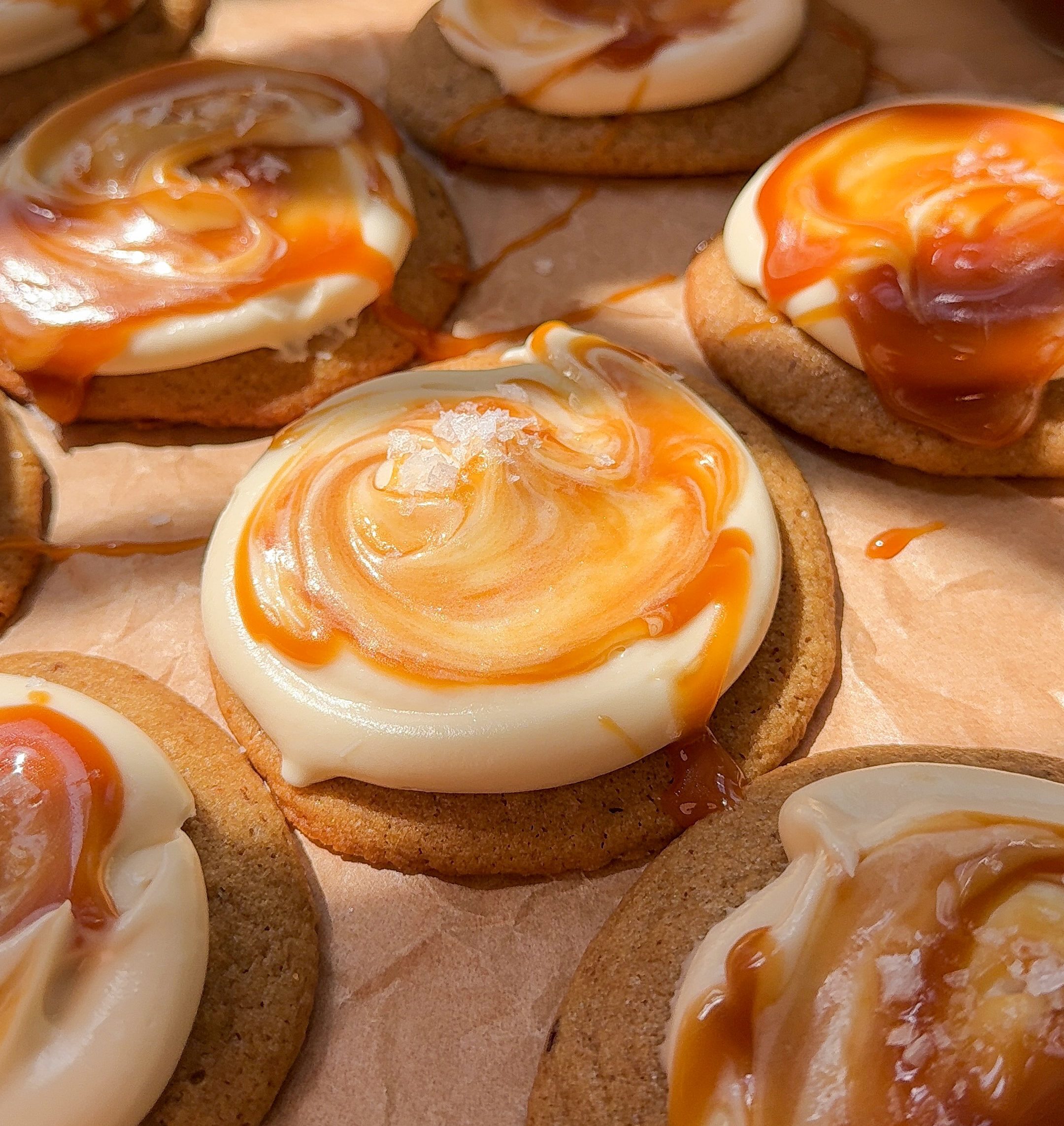
Salted Caramel Espresso Cookies — Light & Fluffy Cookies with Cream Cheese Frosting
Ingredients
- ¾ cup unsalted butter, room temperature
- ½ cup light brown sugar, packed
- ½ cup granulated sugar
- 2 large eggs, room temperature
- 1 teaspoon vanilla extract
- 2 cups all-purpose flour
- 2 tablespoons instant espresso powder
- 11/2 teaspoon cornstarch
- 11/2 teaspoons baking powder
- ½ teaspoon fine sea salt
- 8 oz cream cheese, room temperature
- 4 tablespoons unsalted butter, room temperature
- 1 teaspoon vanilla extract
- 2 cups powdered sugar, sifted
- ~1/8 cup salted caramel sauce — I use my homemade version but store-bought works perfectly here.
- Flaky sea salt for finishing
Instructions
- Cream the butter & sugars:In the bowl of a stand mixer (or a large bowl with a hand mixer), beat 170 g (¾ cup) unsalted butter, 110 g brown sugar, and 100 g granulated sugar on medium-high for about 2 minutes, until the mixture is light, creamy, and a little fluffy. Scrape the bowl down once or twice — well-creamed butter = lighter cookies.
- Baking tip: Room-temp butter should give slightly under-ripe peanut butter consistency. If your butter is too cold, pop it in microwave for 5–8 seconds — don’t melt it.
- Baking tip: Room-temp butter should give slightly under-ripe peanut butter consistency. If your butter is too cold, pop it in microwave for 5–8 seconds — don’t melt it.
- Add eggs & vanilla:Add 2 room-temp eggs one at a time, beating about 20–30 seconds after each addition. Add 1 tsp vanilla and mix until incorporated. The batter will look glossy and smooth.
- Add dry ingredients:In a separate bowl, whisk together 240 g (2 cups) all-purpose flour, 10 g (2 tbsp) instant espresso powder, 2.6 g (1 tsp) cornstarch, 6.9 g (1½ tsp) baking powder, and 3 g (½ tsp) salt. Add the dry mix to the wet ingredients and mix on low until just combined — don’t overmix. Stop as soon as visible streaks of flour disappear.
- Baker’s note: The espresso powder dissolves best if you whisk it into the flour, but if your powder clumps a little you can bloom it in 1 tbsp hot water and add as part of the wet ingredients.
- Baker’s note: The espresso powder dissolves best if you whisk it into the flour, but if your powder clumps a little you can bloom it in 1 tbsp hot water and add as part of the wet ingredients.
- Scoop & chill (two options):
- Option A (my preference): Scoop dough into 16 even mounds using a 2-tablespoon scoop (≈40–45 g per cookie) directly onto the lined baking sheets — 8 per sheet, spaced ~2” apart. Then refrigerate the scooped sheet(s) for 30 minutes. Chilled scooped dough bakes up a bit taller. Option B: Refrigerate the entire dough ball for 30 minutes, then scoop. The dough will be firmer and easier to form into perfectly round mounds, but it takes a bit longer to scoop. Either way, chilling helps control spread and deepens flavor.
- Option A (my preference): Scoop dough into 16 even mounds using a 2-tablespoon scoop (≈40–45 g per cookie) directly onto the lined baking sheets — 8 per sheet, spaced ~2” apart. Then refrigerate the scooped sheet(s) for 30 minutes. Chilled scooped dough bakes up a bit taller. Option B: Refrigerate the entire dough ball for 30 minutes, then scoop. The dough will be firmer and easier to form into perfectly round mounds, but it takes a bit longer to scoop. Either way, chilling helps control spread and deepens flavor.
- Option A (my preference): Scoop dough into 16 even mounds using a 2-tablespoon scoop (≈40–45 g per cookie) directly onto the lined baking sheets — 8 per sheet, spaced ~2” apart. Then refrigerate the scooped sheet(s) for 30 minutes. Chilled scooped dough bakes up a bit taller.
- Option B: Refrigerate the entire dough ball for 30 minutes, then scoop. The dough will be firmer and easier to form into perfectly round mounds, but it takes a bit longer to scoop.
- Either way, chilling helps control spread and deepens flavor.
- Preheat:Preheat your oven to 375°F (190°C).
- Bake:Bake in the preheated oven at 375°F (190°C) for 12–13 minutes, rotating pans halfway if needed. You want the edges just starting to turn golden while the centers still look soft. Cookies will continue to set as they cool.
- Cool:Remove from oven and let cookies cool on the sheet for 5 minutes, then transfer to a cooling rack to cool completely before frosting. If you frost too early, the frosting will melt and slide off.
- Make the frosting:
- In a medium bowl, beat 226.8 g (8 oz) cream cheese and 56.7 g (4 tbsp) butter, both room temperature, with 1 tsp vanilla, until light and silky — 1–2 minutes.
- Gradually add 240 g (2 cups) powdered sugar, beating on low until sugar is incorporated, then on medium-high until frosting is light and smooth. If your frosting seems too loose, add a little more powdered sugar 1 tbsp at a time; too stiff — add a tsp of milk. Chill 10 minutes if it feels too soft to pipe.
- Pipe & caramel:
- Use a piping bag with a round tip (or cut a ½” hole) and pipe a generous swirl of cream cheese frosting onto each cooled cookie. I like a nice mound — it looks bakery-level and holds the caramel.
- Spoon or drizzle about 1–2 teaspoons (total per cookie — remember the whole recipe uses about 1/8 cup) of salted caramel over each frosted cookie. I like to place a small dollop then use the back of a spoon to smear it into the frosting for a pretty, slightly messy look.
- Finish with a pinch of flaky sea salt.
- Presentation tip: If your caramel is runny, chill it in the fridge for 10–15 minutes to thicken slightly; if too stiff, warm gently in the microwave for 6–8 seconds.
Video
Tips & Tricks for the BEST Cookies!!
-
Chill the dough – Even just 30 minutes helps control spread and keeps cookies tall and fluffy.
-
Scoop before chilling – Dough is easier to portion when soft, and scooped cookies chill faster.
-
Watch the bake time – Pull cookies when the edges are just barely golden; they’ll finish setting as they cool.
-
Cool completely before frosting – Warm cookies will melt the frosting and caramel into a slippery mess.
-
Thicken runny caramel – Chill in the fridge for 10–15 minutes before drizzling for more control.
-
Flaky salt at the end – Add it right before serving so it stays crisp instead of dissolving into the frosting.
Storage Instructions
-
Frosted cookies: Store in an airtight container in the fridge for up to 5 days. Let come to room temperature before serving for best texture (about 30–45 minutes).
-
Unfrosted cookies: Keep at room temp in an airtight container for up to 3 days, or freeze for up to 3 months. Reheat gently (10–12 seconds in microwave) before frosting.
-
Caramel: If you make homemade caramel, keep it refrigerated and warm gently before using.
More of my recipes
Do you LOVE Coffee?! Check Out More of my Favs:Tiramisu Cinnamon Rolls | Espresso‑Infused Twists on a Classic Sweet Roll Best Dark Chocolate Espresso Banana Bread Recipe | Rich and Moist (with VIDEO) Homemade Salted Caramel Latte (Iced or Hot!) with From-Scratch SyrupConclusion
If you make them, tag me or drop a comment and tell me whether you went full-on espresso or dialed it back. I love hearing tweaks and seeing your cookies — bonus points for that messy caramel smear. Want a printable card-style recipe or step-by-step photos for the blog post? I can write a Pinterest-friendly recipe card, create a shortened version for IG captions, or turn this into a long-form blog post in your voice with SEO-friendly headings — tell me which you want next and I’ll write it up.
Happy baking — and yes, these are dangerously good. ☕🍪✨








Leave a Reply Cancel reply